



Emergency Medical Technician Program
Frontline emergency care — hands-on preparation for EMT certification and clinical response.
Have Questions? Ask Us!
Learn More
Program at a Glance
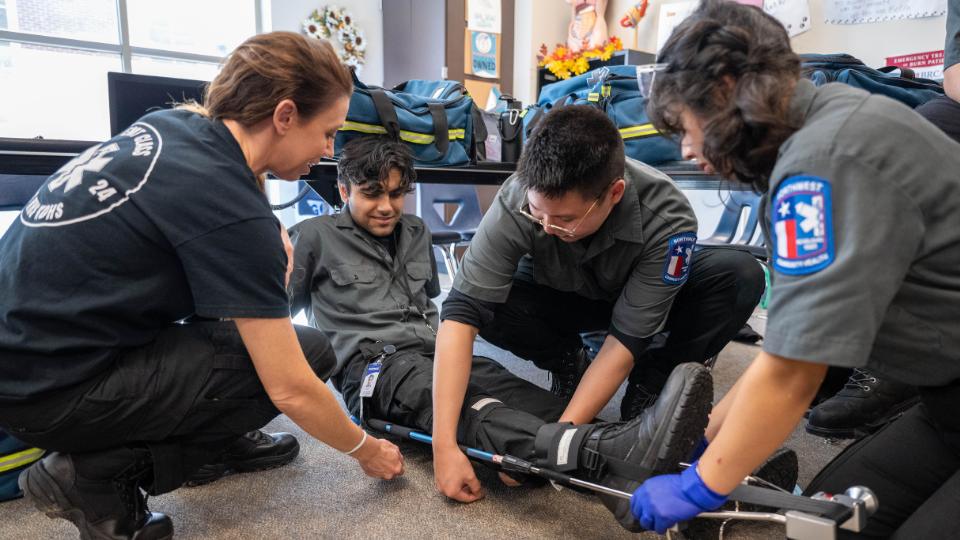
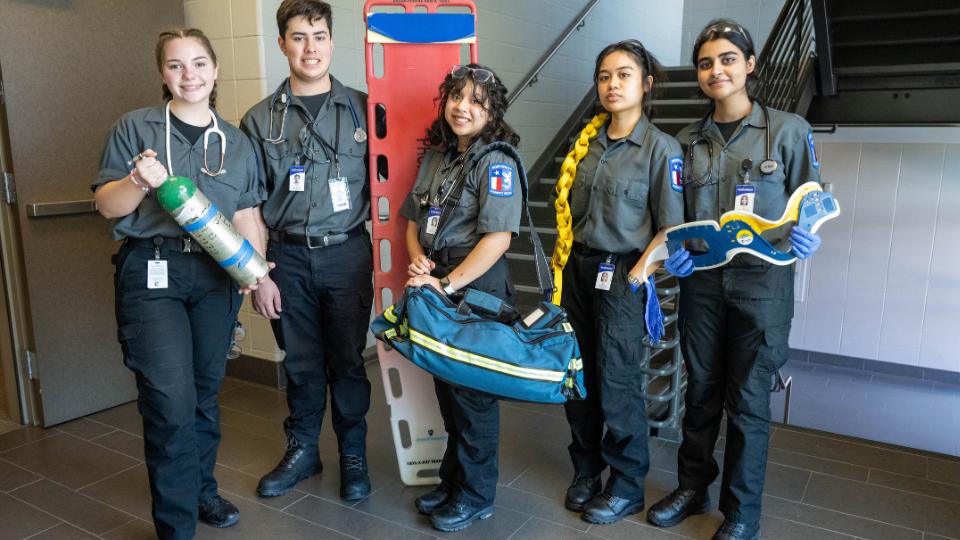
The Emergency Medical Technician Program provides students with advanced training in emergency response, patient assessment, and life-saving procedures used in pre-hospital and clinical settings. This rigorous, fast-paced pathway prepares students for real-world emergency situations through hands-on medical labs, scenario-based training, and professional healthcare coursework. It is ideal for students interested in becoming EMTs, paramedics, firefighters, emergency responders, or pursuing further medical or nursing education.
Highlights
Students begin with Principles of Health Science and Medical Terminology, building the medical vocabulary, anatomy knowledge, and foundational health concepts essential for emergency care. At Level 3, students take Health Science Theory, gaining exposure to healthcare systems, disease processes, and patient care practices while earning CPR (BLS) Certification. In their senior year, students enter the Practicum in Health Science – EMT, the capstone course where they complete clinical hours, perform hands-on emergency skills, and prepare for the Emergency Medical Technician Certification.
Alongside the EMT practicum, students also complete Anatomy & Physiology or its dual credit equivalent through Lone Star College, reinforcing the biological and physiological knowledge necessary for emergency medical practice. This program is available on limited campuses, making it one of Klein ISD’s more specialized and competitive health science pathways.
Benefits & Educational Outcomes
Students graduate with strong medical knowledge, clinical skills, and professional competencies needed to respond quickly and effectively in emergency situations. They learn patient assessment, airway and breathing management, trauma response, cardiac care, and basic life support procedures used daily by EMTs and paramedics. Completion of the program prepares students to sit for the EMT certification exam, enabling them to enter the workforce immediately as certified Emergency Medical Technicians.
Students earn CCMR credit, gain real clinical experience, and develop communication, teamwork, and critical thinking skills essential for all health professions. Whether students continue into paramedicine, nursing, medical school, or related healthcare fields, the program gives them a strong, career-ready foundation in emergency medical services.
Is this program right for your student?
Where will you find this program?


Leave a Review for Emergency Medical Technician Program

Supplemental Online Courses
Tuition-Based Courses taken Virtually Outside Regular School Hours
- Intermediate, High School

Flex Scheduling Program
Primarily Online Schooling with On-Campus Opportunities
- Intermediate, High School

Full Time Virtual Program
Complete Online Educational Experience
- Intermediate, High School

Geometry (Intermediate)
Visual reasoning, proof, and real-world modeling — an accelerated geometry course that builds spatial sense and rigorous mathematical argument.
- Intermediate

Algebra (Intermediate)
Algebraic thinking, problem solving, and college-minded rigor — the Grade 8 Algebra experience for advanced intermediate learners.
- Intermediate


Biology (Intermediate)
Inquiry, lab skills, and college-minded science — Grade 8 Biology taught with high-school rigor.
- Intermediate


Fashion Design Program
Design, construction, and creative entrepreneurship in fashion and apparel.
- High School


Future Teacher College Program
College-aligned preparation for education careers — practicum, certification, and pathway advising.
- High School


Geospatial Engineering & Land Surveying College Program
Mapping, surveying, and geospatial systems — hands-on training aligned to college credit.
- High School


Global Business College Program
- High School